

blog

Three ways to argue over arguments

UPDATE: Contribute information on how your language identifies its arguments here.

When we execute a command in Ubiquity, in very simple terms, we’re hoping to do something (a verb) to some arguments (the nouns). Every sentence in every language uses some method to encode which arguments correspond to which roles of the verb. Here are a couple examples:

1
2
He sees Mary.
彼が Maryを 見る。 (Kare-ga Mary-o miru.)

As speakers of English, you can read sentence (1) above and know exactly who is doing the seeing and who is being seen and speakers of Japanese can get the same information from (2). How do different languages code for arguments in different roles? There are, broadly speaking, three different ways:
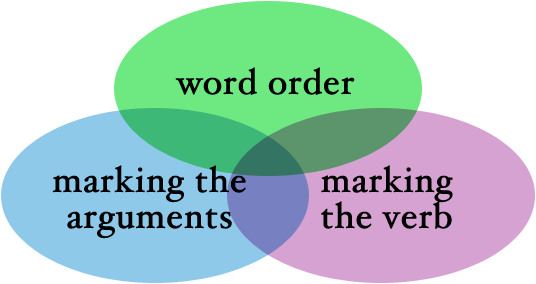
three ways to code for arguments in different roles

We’ll take a brief look today at these three different strategies, all of which a localizeable natural language interface will surely encounter.

Word order

In many languages, the position of the arguments relative to one another and to the verb determine the roles which each argument will play. Mandarin Chinese is a good example of such a language:

3
4
他 喜欢 Mary (Ta xihuan Mary)
Mary 喜欢 他 (Mary xihuan ta)

Here, sentence (3) says “he likes Mary” while sentence (4) says “Mary likes him”. Simply reversing the positions of “he/him” and “Mary” we’re able to flip the roles that they fill in the sentence: that of the person who does the liking and the person who is being liked. Now take a look at sentence (5) which means “John says ‘hello’ to Mary.”

5
John 告诉 Mary "你 好" (John gaosu Mary "ni hao")

We note here that, while in English we used a different strategy of marking one argument (we marked the “hello” argument with “to”), Chinese doesn’t mark either of the arguments. There is, however, a clearly defined order to the arguments, which you might encode this way:

say [who you're speaking to] [what you're saying]

If you swap the order of the two objects in this sentence, it becomes ungrammatical. (Note: the asterisk * here means the sentence is ungrammatical.)

5
* John 告诉 "你 好" Mary (John gaosu "ni hao" Mary)

Here, the word order dictates that “你好” must be “who you’re speaking to” and “Mary” must be “what you’re saying,” but that doesn’t make sense, so the sentence is ungrammatical.

Marking the arguments

Another possible strategy is to mark each argument (or some of the arguments) so that each argument’s role is clear. In many languages this is done with case marking. Take for example this Ancient Greek sentence with its English gloss on line (6). Here, NOM refers to nominative case and ACC refers to accusative case.1

5
6
ho  didaskal-os  paideuei to  paidi-on  (SVO)
the teacher -NOM teaches  the boy  -ACC

This sentence means “the teacher instructs the boy.” While sentence (5) is in Subject-Verb-Object order, any of the six possible orderings of {subject, verb, object} are also grammatical and mean the same thing:2

7
8
9
10
11
ho didaskalos to paidion paideuei (SOV)
paideuei ho didaskalos to paidion (VSO)
paideuei to paidion ho didaskalos (VOS)
to paidion ho didaskalos paideuei (OSV)
to paidion paideuei ho didaskalos (OVS)

Many languages also use adpositions (prepositions and/or postpositions) to further clarify the role of an argument in addition to case (like English does) or in lieu of case marking altogether. The idea is the same, though: you want to clarify the roles of the arguments so you morphologically mark the arguments with their roles.

Marking the verb

Many languages mark the verb with some information about the argument in a certain role, so that we can properly identify the argument’s roles. This kind of phenomenon is called agreement.

The most common type of verbal agreement is subject agreement, where the verb is marked by a specific form depending on some features of the subject. Anyone who’s taken French 101 will recognize this verb conjugation paradigm:

subjectêtre (to be)
singularje (I)suis
tu (you)es
il/elle (he/she)est
pluralnous (we)sommes
vous (plural you)êtes
ils (they)sont

With this paradigm, if you hear or see “suis” in a French sentence, you immediately know that “je” (I) must be the subject and if you see “sommes,” “nous” (we) is the subject, etc. Standard Average European languages tend to exhibit this sort of subject-verb agreement.

Features of the subject position aren’t the only thing that can be marked on the verb, though. Hungarian, for example, has a type of object agreement. Specifically, the verb marks whether the object is definite or not (in linguistics lingo, “the verb agrees with the object’s definiteness feature”).

12
13
14
15
John lát  egy almát.
John sees an  apple
John látja az  almát.
John sees  the apple

Notice that in sentence (12) (glossed in (13)) the verb for “see” is realized as “lát,” while in (14) it’s “látja.” A speaker can use that agreement to see whether the object is definite or not and thus limit the possible object arguments out of all the nouns in the sentence.

All of the above
whom.gif

Most languages do not use only one of these strategies, but a combination of them. English is a very good example. In a sentence like (12) below the main coding of grammatical roles seems to be word order alone. By reversing the word order into (13), we can effectively swap the argument’s roles.

12
13
John likes Mary.
Mary likes John.

However, this doesn’t work with pronominal arguments. Swapping the arguments in (14) yields (15) which is ungrammatical due to the case marking on the pronouns.

14
15
He likes her.
* Her likes he.

In addition, the verb in English must agree with the subject’s number (singular or plural):

16
17
18
John likes them.
* They likes John.
They like John.

In this way, English exhibits all three strategies: word order, case marking, and agreement, although often only word order is actively used to disambiguate the roles of arguments.

Question: What strategies are used by your language to mark the roles of different arguments?


  1. The following example is from Holger Diessel

  2. “Mean the same thing” here means that the teacher is always instructing and the boy is always being instructed. The sentences may differ in when or how they are used depending on which argument is being talked about or what the implications of the utterance are. The formal notion is truth-conditional equivalence

Related posts:

  1. Contribute: how your language identifies its arguments
  2. Writing commands with semantic roles
  3. Ubiquity in Firefox: Focus on Japanese
  4. Adding Your Language to Ubiquity Parser 2
  5. Rolling out the Roles

Related posts brought to you by Yet Another Related Posts Plugin.

Tags: , , , , , , , , , , , , , , , , ,

If you enjoyed this post, make sure you subscribe to my RSS feed (optionally with tweets from my Twitter)!

This website uses IntenseDebate comments, but they are not currently loaded because either your browser doesn't support JavaScript, or they didn't load fast enough.

13 Responses to “Three ways to argue over arguments”

  1. Blair McBride Says:

    Wow, this brings back memories of the linguistics and Latin courses I did at university.

  2. mitchoyoshitaka Says:

    That's the idea! ^^

  3. mitcho > blog > Contribute: how your language identifies its arguments Says:

    […] blog blog « Three ways to argue over arguments […]

  4. Alberto Santini Says:

    Ok… after revisiting my knowledge about Latin and Ancient Greek, I look forward to reading your next post about consecutio temporum or the verbal tense aoristo. :)

    Maybe it would be interesting comparing those strategies with the programming languages ones. It seems to me they use a word order strategy (the syntax) and an adposition technique using punctuations.

    Grabbing the idea, Ubiquity linguistic interface might use a semi-natural language approach, mixing different strategies between natural and programming languages. I think the main point is building an interface with a strong inner coherence - same strategies for same use cases.

    Again the kind of coherence (what strategies using) might be customized by the user.

  5. Aza Raskin Says:

    Mitcho, great post. I feel my brain is a bit bigger; and the free space a bit smaller.

  6. mitcho > blog > Ubiquity in Firefox: Japanese Says:

    […] of prepositions, direct objects come before verbs, and adjectives precede nouns. In terms of how it identifies its arguments, every argument has a postposition/case marker (called a particle in the Japanese literature) which […]

  7. Panic And Anxiety Attack Information - We all experience anxiety to one degree or another | Tips For Panic Attacks Says:

    […] mitcho > blog > Three ways to argue over arguments […]

  8. unhammer Says:

    Nice post! I feel like I should recommend it to my linguistics lecturers.

    I added N on verbal marking and Y on argument marking for Norwegian in your Google Doc. Norwegian has no verbal agreement; compared to English the only difference in case marking in most dialects is that we still have "thou vs thee" (but there are enough prepositions). Swedish and Danish are fairly similar. Georgian, which I'm reading about now, has fairly "free" word order, a whole lot of verbal agreement (including a little bit of object agreement) and a bunch of cases..

  9. Ubiquity i18n: questions to ask Says:

    […] to these surveys would be used to identify certain salient features of the language, such as how the language codes for its arguments (for example using adpositions, case marking, or word order), whether the commands tend to be […]

  10. Attachment Ambiguity—or—when is the gyudon cheap? Says:

    […] attachment ambiguity was possible because there was no clear marker on “April 15th,” which may have disambiguated it as “on April 15th”. In […]

  11. In Case of Case… Says:

    […] ave multiple different strategies for accomplishing similar communicative tasks. One oft-used strategy for marking different roles of arguments is the use of adpositions (a fancy term for prepositions and postpositions). Unlike case-markers which oft […]

  12. tayor mize Says:

    Visualization has long been used for a variety of physical and psychological problems for thousands of years. The mind is a powerful thing — especially the subconscious mind. By visualizing, you'll be tapping into the power your mind has to heal. Even if you've never tried this before, you'll definitely want to, as it can help you get rid of your panic attacks.

    When you feel a panic attack coming on, you can close your eyes and start to visualize whatever helps you the most. For some people, visualizing a humorous experience is the best medicine. Visualize having uncontrolled laughter that takes over your whole body and makes it shake with pleasure. This is a good method because laughter is healing and will counteract the feelings of panic or fear you've been getting from the panic attacks.

    You can also visualize yourself in a peaceful and calm place. You can literally feel like you are removed from the fearful situation and are somewhere peaceful — like the beach or staring at a snow capped mountain. Imagine the setting in as vivid detail as possible.

    It might be difficult for first time people to visualize effectively. For that reason, you might consider getting some CDs or a video to help you with this process. There are several out there on the market that will be immensely helpful for you. Some therapists even specialize in visualization, so you can make an appointment with them and they can teach you some techniques.

    No matter what you do, definitely give visualization a try. If you think about it, when you're in the midst of a panic attack you start to have irrational fears. Pictures often flash through your mind. This causes even more symptoms — your heart might palpitate, and you may even feel like you are dying. It's all because of what is in your mind and what you are picturing.

    By replacing these scary images with something peaceful, funny, pleasant — whatever — you can more easily get over your panic attacks and start to realize that your fears are irrational. You'll feel like all is right in the world after all.

    As was already mentioned, you might even feel a little bit silly doing this at first, and it can be difficult for you. Practice truly does make perfect! The first few times you do this, you might find the method is unsuccessful. However, if you stick with it and allow your conscious and subconscious mind to think of peaceful things, you can beat your panic attacks.http://www.health-n-beautytips.com/php/panic/ " target="_blank">anxiety attacks symptoms

  13. Order web design Says:

    All these 3 ways over argumentation are very interesting and specific.


© 2006-2008 mitcho (Michael 芳貴 Erlewine).
Proudly powered by WordPress.
Entries (RSS) and Comments (RSS).
The views expressed on these pages are mine alone and do not
reflect those of my employers and clients, past and present.