

blog

Unnatural by design

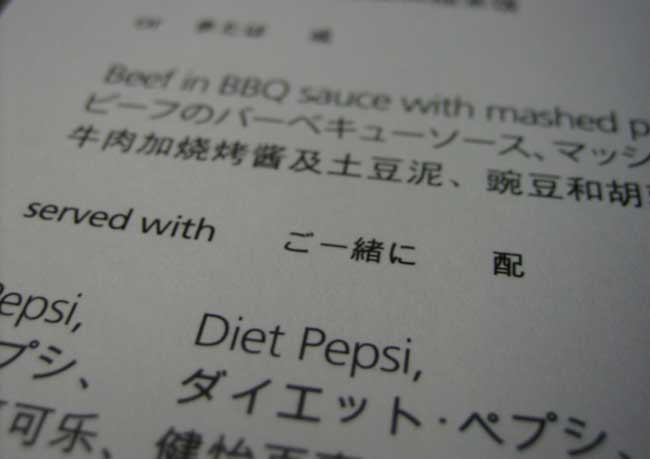
I’m flying over the pacific ocean right now but a little bit of language caught my eye. Here’s a picture of the menu for this flight, in three languages: English, Japanese, Chinese.
menu.jpg

What caught my eye is the line “served with ご一緒に 配,” meant to be read as part of “Beef in BBQ sauce… served with Pepsi…”. The Chinese 配 (pèi) is fine here, meaning “with,” but the Japanese “ご一緒に” (goissho-ni) seemed awkward to me.

The issue is that this adverbial meaning “together” normally comes after the “what it’s with” in an order like (1) (glossed in (2)):

1
2
A B-と       ご一緒に
A B-and/with together

In other words, where English and Chinese both would say “A with B”, it is most natural in Japanese to say the equivalent of “A B with (together)”.1 This is the reason why it seems unnatural to have anything between the “Beef in BBQ sauce…” line and “Pepsi…” line.

Looking at the rest of the menu, it’s clear that this isn’t a case where a native speaker wasn’t involved with the writing of the menu—the rest of the Japanese is perfect. The Japanese modifier was inserted there just for the sake of parallel design, to the detriment of the text’s naturalness. When have you seen design conflict with the structure of your language?


  1. This can be generalized to a certain extent by noting that English and Chinese are both head-initial (aka “right branching”) languages, while Japanese is strongly head-final (aka “left branching”). 

Related posts:

  1. Where’s The Verb?
  2. Attachment Ambiguity—or—when is the gyudon cheap?
  3. Adding Your Language to Ubiquity Parser 2
  4. Three ways to argue over arguments
  5. Ubiquity in Firefox: Focus on Japanese

Related posts brought to you by Yet Another Related Posts Plugin.

Tags: , , , , , , , ,

If you enjoyed this post, make sure you subscribe to my RSS feed (optionally with tweets from my Twitter)!

5 Responses to “Unnatural by design”

  1. hangfromthefloor Says:

    It seems "unnatural" to use 配 (pèi) here as well; according to what I've been taught, 和 (hé), and sometimes 與 (yǔ), serves the purpose of the preposition “with.”

    But I could be wrong – you're the linguist :o )

  2. Alberto Santini Says:

    Near the army barracks I read quite often a signal warning "Uscita militari" (literally "exit militaries"), meaning "soldiers exit". This is an error because (in italian) there is a past participle with an adjective (and not a noun) resulting the sentence not well formed. I think it was a fault due to shortening the sentence "Exit military men": why not cutting "men" word? A case of (false) naturalness vs. correctness.

  3. kourge Says:

    One of the unnatural structures that I commonly face when localizing something is a string taking the form of something like: "Downloading %s", where %s could be a new version, an add-on, or some component; in other words, clauses with a verb in present continuous / progressive form. (現在進行式)

    The good thing is that in this case, there is a placeholder %s. The problem is that lots of programmers assume such a structure and only give out the string "downloading" to the localizer with no context or placeholder whatsoever. "Downloading?" Downloading what? "%s is downloading?" "Finished downloading %s?" "Downloading %s?"

    With no context at all, I could translate "downloading" into any of the following forms in Chinese: "下載 %s 中" ("[Download] %s [-ing]") "正在下載 %s" ("[In the process of] downloading %s") "目前正在下載 %s 中" ("%s [is] currently [being] download[ed]") "%s 已下載完畢" ("%s [is] finished downloading") or even: "已下載 %s" ("Downloaded %s")

    Of the above five forms, if the developer assumed that no placeholders would be needed, the feasibly possible translations would be reduced to only three.

    To a larger scale, the very common passive voice in English sounds eerily unnatural in Chinese. These kinds of sentences usually get translated into an active voice with no subject. Even though Chinese isn't as pro-drop as Japanese, a null subject sentence still sounds better than one in a passive voice. When a developer decides that the subject needn't be a placeholder in a string, the Chinese translator / localizer is, from time to time, forced to translate the sentence into one with an unnatural passive voice.

  4. Axel Hecht Says:

    Japanese is a prominent edge case in quite a few places where we concatenate strings within Mozilla UI. They're the one language I know about that hides "Firefox" in the UI every know and then, for example.

  5. mitcho Says:

    kourge - thanks for your detailed reply! It's great to see how these different word orders and structures are natural or unnatural in Chinese… this makes a good case for offering strings to localize in terms of "usage contexts" instead of simply individual words.


© 2006-2010 mitcho (Michael 芳貴 Erlewine).
Proudly powered by WordPress.
Entries (RSS) and Comments (RSS).
The views expressed on these pages are mine alone and do not
reflect those of my employers and clients, past and present.